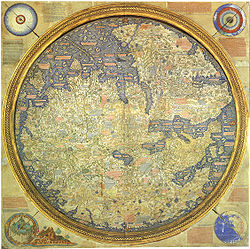
 | Cartography, or mapmaking, has been an integral part of the human history for a long time, possibly up to 8,000 years. From cave paintings to ancient maps of Babylon, Greece, and Asia, through the Age of Exploration, and on into the 21st century, people have created and used maps as the essential tools to help them define, explain, and navigate their way through the world. Mapping represented a significant step forward in the intellectual development of human beings and it serves as a record of the advancement of knowledge of the human race, which could be passed from members of one generation to those that follow in the development ofculture. Maps began as two-dimensional drawings. Although that remains the nature of most maps, modern graphics have enabled projections The earliest known maps are of the heavens, not the earth. Dots dating to 16,500 BCE found on the walls of the Lascaux caves map out part of the night sky, including the three bright starsVega, Deneb, and Altair (the Summer Triangle asterism), as well as the Pleiades star cluster. The Cuevas de El Castillo in Spain contain a dot map of the Corona Borealis constellation dating from 12,000 BCE. Cave painting and rock carvings used simple visual elements that may have aided in recognizing landscape features, such as hills or dwellings. A map-like representation of a mountain, river, valleys and routes around Pavlov in the Czech Republic has been dated to 25,000 BP, and a 14,000 BP polished chunk of sandstone from a cave in Spanish Navarre may represent similar features superimposed on animal etchings, although it may also represent a spiritual landscape, or simple incisings. Another ancient picture that resembles a map was created in the late 7th millennium BCE in Çatalhöyük, Anatolia, modern Turkey. This wall painting may represent a plan of this Neolithic village; however, recent scholarship has questioned the identification of this painting as a map. Whoever visualized the Çatalhöyük "mental map" may have been encouraged by the fact that houses in Çatalhöyük were clustered together and were entered via flat roofs. Therefore, it was normal for the inhabitants to view their city from a bird's eye view. Later civilizations followed the same convention; today, almost all maps are drawn as if we are looking down from the sky instead of from a horizontal or oblique perspective. The logical advantage of such a perspective is that it provides a view of a greater area, conceptually. There are exceptions: one of the "quasi-maps" of the Minoan civilization on Crete, the “House of the Admiral” wall painting, dating from c. 1600 BCE, shows a seaside community in an oblique perspective. Early Greek mapsIn classical antiquity, maps were drawn by Anaximander, Hecataeus of Miletus, Herodotus, Eratosthenes, and Ptolemy using both observations by explorers and a mathematical approach. Early steps in the development of intellectual thought in ancient Greece belonged to Ionians from their well-known city of Miletus in Asia Minor. Miletus was placed favourably to absorb aspects ofBabylonian knowledge and to profit from the expanding commerce of the Mediterranean. The earliest ancient Greek who is said to have constructed a map of the world is Anaximander of Miletus (c. 611–546 B.C.), pupil of Thales. He believed that the earth was a cylindrical form, like a stone pillar and suspended in space.[12] The inhabited part of his world was circular, disk-shaped, and presumably located on the upper surface of the cylinder (Brown, 24). Anaximander was the first ancient Greek to draw a map of the known world. It is for this reason that he is considered by many to be the first mapmaker (Dilke, 23). A scarcity of archaeological and written evidence prevents us from giving any assessment of his map. What we may presume is that he portrayed land and sea in a map form. Unfortunately, any definite geographical knowledge that he included in his map is lost as well. Although the map has not survived, Hecataeus of Miletus (550–475 B.C.) produced another map fifty years later that he claimed was an improved version of the map of his illustrious predecessor. Hecatæus's map describes the earth as a circular plate with an encircling Ocean and Greece in the centre of the world. This was a very popular contemporary Greek worldview, derived originally from the Homeric poems. Also, similar to many other early maps in antiquity his map has no scale. As units of measurements, this map used "days of sailing" on the sea and "days of marching" on dry land (Goode, 2). The purpose of this map was to accompany Hecatæus's geographical work that was called Periodos Ges, or Journey Round the World (Dilke, 24). Periodos Ges was divided into two books, "Europe" and "Asia", with the latter including Libya, the name of which was an ancient term for all of the known Africa. The work follows the assumption of the author that the world was divided into two continents, Asia and Europe. He depicts the line between the Pillars of Hercules through the Bosporus, and the Don River as a boundary between the two. Hecatæus is the first known writer who thought that the Caspian flows into the circumference ocean—an idea that persisted long into the Hellenic period. He was particularly informative on the Black Sea, adding many geographic places that already were known to Greeks through the colonization process. To the north of the Danube, according to Hecatæus, were the Rhipæan (gusty) Mountains, beyond which lived the Hyperboreans—peoples of the far north. Hecatæus depicted the origin of the Nile River at the southern circumference ocean. His view of the Nile seems to have been that it came from the southern circumference ocean. This assumption helped Hecatæus solve the mystery of the annual flooding of the Nile. He believed that the waves of the ocean were a primary cause of this occurrence (Tozer, 63). It is worth mentioning that a similar map based upon one designed by Hecataeus was intended to aid political decision-making. According to Herodotus, it was engraved upon a bronze tablet and was carried to Sparta by Aristagoras during the revolt of the Ionian cities against Persian rule from 499 to 494 B.C. Anaximenes of Miletus (6th century B.C.), who studied under Anaximander, rejected the views of his teacher regarding the shape of the earth and instead, he visualized the earth as a rectangular form supported by compressed air. Pythagoras of Samos (c. 560–480 B.C.) speculated about the notion of a spherical earth with a central fire at its core. He is also credited with the introduction of a model that divides a spherical earth into five zones: one hot, two temperate, and two cold—northern and southern.[citation needed] It seems likely that he illustrated his division in the form of a map, however, no evidence of this has survived to the present. Scylax, a sailor, made a record of his Mediterranean voyages in c. 515 B.C.. This is the earliest known set of Greek periploi, or sailing instructions, which became the basis for many future mapmakers, especially in the medieval period.[13] The way in which the geographical knowledge of the Greeks advanced from the previous assumptions of the Earth's shape was through Herodotus and his conceptual view of the world. This map also did not survive and many have speculated that it was never produced. A possible reconstruction of his map is displayed below. Herodotus traveled very extensively, collecting information and documenting his findings in his books on Europe, Asia, and Libya. He also combined his knowledge with what he learned from the people he met. Herodotus wrote his Histories in the mid-5th century B.C. Although his work was dedicated to the story of long struggle of the Greeks with the Persian Empire, Herodotus also included everything he knew about the geography, history, and peoples of the world. Thus, his work provides a detailed picture of the known world of the 5th century B.C.. Herodotus rejected the prevailing view of most 5th century B.C. maps that the earth is a circular plate surrounded by Ocean. In his work he describes the earth as an irregular shape with oceans surrounding only Asia and Africa. He introduces names such as the Atlantic Sea and the Erythrean Sea. He also divided the world into three continents: Europe, Asia, and Africa. He depicted the boundary of Europe as the line from the Pillars of Hercules through the Bosporus and the area between Caspian Sea and Indus River. He regarded the Nile as the boundary between Asia and Africa. He speculated that the extent of Europe was much greater than was assumed at the time and left Europe's shape to be determined by future research. In the case of Africa, he believed that, except for the small stretch of land in the vicinity of Suez, the continent was in fact surrounded by water. However, he definitely disagreed with his predecessors and contemporaries about its presumed circular shape. He based his theory on the story of Pharaoh Necho II, the ruler of Egypt between 609 and 594 B.C., who had sentPhoenicians to circumnavigate Africa. Apparently, it took them three years, but they certainly did prove his idea. He speculated that the Nile River started as far west as the Ister River in Europe and cut Africa through the middle. He was the first writer to assume that the Caspian Sea was separated from other seas and he recognised northern Scythia as one of the coldest inhabited lands in the world. Similar to his predecessors, Herodotus also made mistakes. He accepted a clear distinction between the civilized Greeks in the centre of the earth and the barbarians on the world's edges. In hisHistories we can see very clearly that he believed that the world became stranger and stranger when one traveled away from Greece, until one reached the ends of the earth, where humans behaved as savages. Roman EmpirePomponius Mela (c. 43 CE)Pomponius is unique among ancient geographers in that, after dividing the earth into five zones, of which two only were habitable, he asserts the existence ofantichthones, inhabiting the southern temperate zone inaccessible to the folk of the northern temperate regions from the unbearable heat of the intervening torrid belt. On the divisions and boundaries of Europe, Asia and Africa, he repeats Eratosthenes; like all classical geographers from Alexander the Great (except Ptolemy) he regards the Caspian Sea as an inlet of the Northern Ocean, corresponding to the Persian and Arabian (Red Sea) gulfs on the south.5th-century Roman road mapIn 2007, the Tabula Peutingeriana, a 12th-century replica of a 5th-century map, was placed on the UNESCO Memory of the World Register and displayed to the public for the first time. Although well preserved and believed to be an accurate copy of an authentic original, the scroll media it is on is so delicate now it must be protected at all times from exposure to daylight. |


India

Indian cartographic traditions covered the locations of the Pole star and other constellations of use.These charts may have been in use by the beginning of the Common Era for purposes of navigation.
Detailed maps of considerable length describing the locations of settlements, sea shores, rivers, and mountains were also made. The 8th century scholarBhavabhuti conceived paintings which indicated geographical regions.
European scholar Francesco I reproduced a number of ancient Indian maps in his magnum opus La Cartografia Antica dell India. Out these maps, two have been reproduced using a manuscript of Lokaprakasa, originally compiled by the polymath Ksemendra (Kashmir, 11th century), as a source.The other manuscript, used as a source by Francesco I, is titled Samgrahani.The early volumes of the Encyclopædia Britannica also described cartographic charts made by the Dravidian people of India.
Maps from the Ain-e-Akbari, a Mughal document detailing India's history and traditions, contain references to locations indicated in earlier Indian cartographic traditions. Another map describing the kingdom of Nepal, four feet in length and about two and a half feet in breadth, was presented to Warren Hastings.In this map the mountains were elevated above the surface, and several geographical elements were indicated in different colors
Arab cartography
In the Middle Ages, Muslim scholars continued and advanced on the mapmaking traditions of earlier cultures. Most used Ptolemy's methods; but they also took advantage of what explorers and merchants learned in their travels across the Muslim world, from Spain to India to Africa, and beyond in trade relationships with China, and Russia.
An important influence in the development of cartography was the patronage of the Abbasid caliph, al-Ma'mun, who reigned from 813 to 833. He commissioned several geographers to remeasure the distance on earth that corresponds to one degree of celestial meridian. Thus his patronage resulted in the refinement of the definition of the mile used by Arabs (mīl in Arabic) in comparison to the stadion used by Greeks. These efforts also enabled Muslims to calculate the circumference of the earth. Al-Mamun also commanded the production of a large map of the world, which has not survived, though it is known that its map projection type was based on Marinus of Tyre rather than Ptolemy.
Also in the 9th century, the Persian mathematician and geographer, Habash al-Hasib al-Marwazi, employed the use spherical trigonometry and map projection methods in order to convert polar coordinates to a different coordinate system centred on a specific point on the sphere, in this the Qibla, the direction to Mecca.Abū Rayhān Bīrūnī (973–1048) later developed ideas which are seen as an anticipation of the polar coordinate system.Around 1025, he describes a polar equi-azimuthal equidistant projection of the celestial sphere. However, this type of projection had been used in ancient Egyptian star-maps and was not to be fully developed until the 15 and 16th centuries.
In the early 10th century, Abū Zayd al-Balkhī, originally from Balkh, founded the "Balkhī school" of terrestrial mapping in Baghdad. The geographers of this school also wrote extensively of the peoples, products, and customs of areas in the Muslim world, with little interest in the non-Muslim realms.The "Balkhī school", which included geographers such as Estakhri, al-Muqaddasiand Ibn Hawqal, produced world atlases, each one featuring a world map and twenty regional maps.
Suhrāb, a late 10th-century Muslim geographer, accompanied a book of geographical coordinates with instructions for making a rectangular world map, with equirectangular projection or cylindrical equidistant projection.The earliest surviving rectangular coordinate map is dated to the 13th century and is attributed to Hamdallah al-Mustaqfi al-Qazwini, who based it on the work of Suhrāb. The orthogonal parallel lines were separated by one degree intervals, and the map was limited to Southwest Asia and Central Asia. The earliest surviving world maps based on a rectangular coordinate grid are attributed to al-Mustawfi in the 14th or 15th century (who used invervals of ten degrees for the lines), and to Hafiz-i Abru (died 1430).
Ibn Battuta (1304–1368?) wrote "Rihlah" (Travels) based on three decades of journeys, covering more than 120,000 km through northern Africa, southern Europe, and much of Asia.
